Fire-Resistant Glass vs. Smoke-Control Glass: Why the Distinction Decides Safety

Brandschutzglas oder Rauchschutzglas? Unterschied, Schutzziele, Feuerwiderstandsklassen E, EW und EI, Einsatzbereiche, Kosten und Planungstipps kompakt erklärt.

When a building catches fire, the first few minutes decide whether people reach safety and whether the structure survives. Heat, rising smoke gases and intense thermal radiation threaten people, assets and the usability of the building all at once. Glazing sits at a critical interface: it closes openings in walls and façades, lets daylight in — and must still protect reliably when it matters most.

This is where a common misconception starts: smoke-control glass is not the same as fire-resistant glass. Depending on its construction, a glass component may only hold back smoke — or additionally shield against thermal radiation and heat. For planners, architects and building owners, that means the choice of glazing is not a matter of taste, but a technical, legal and economic decision.

The following article classifies both glass types, explains the underlying protection goals, shows typical applications and offers guidance on planning, costs and future developments.

How a Fire Develops — and Which Protection Goals Follow

A fire does not spread evenly. Within a short time, temperatures climb steeply, combustible materials ignite, and dense smoke forms. The statistics are clear: for people, smoke is the greatest danger. It takes away visibility, carries toxic gases and blocks escape routes — often long before flames even reach the room.

Glazing in structural fire protection therefore has to do more than simply withstand fire. Depending on the building area, it fulfils different tasks:

  • It seals the room against flames and hot fire gases.
  • It limits the radiated heat.
  • It keeps the temperature rise on the side facing away from the fire within limits.

These three goals give rise to the well-known fire-resistance classes E, EW and EI. And they make clear why smoke-control and fire-resistant glass are two very different things in functional terms.

Learn more about Fire Resistance Classes E, EW and EI

How Fire-Resistant Glass Works Technically

Fire-resistant glazing consists of tested, non-load-bearing components. Its protective effect comes not from the pane alone, but from the coordinated interplay of glass, frame, seals, mountings and fixings.

Many systems react actively to heat in the event of a fire. In modern assemblies, functional interlayers sit between the panes; at high temperatures they change their structure and build up a protective barrier. As a result, flames, smoke and — depending on the system — heat too remain on the fire side. At the same time, these layers absorb the energy of the fire and thus act as thermal insulation.

Decisive here is not only the pane itself, but equally:

  • the specific installation situation,
  • protection against UV radiation during everyday operation,
  • and compatibility with the frame system.

Which technical solution fits depends on the required protection level and the way the building is used.

Smoke-Control Glass vs. Fire-Resistant Glass: The Functional Difference

The difference lies not in the name, but in the protection goal.

Smoke-control glass is designed for room closure. It ensures that smoke and hot fire gases do not pass into adjacent areas. Limiting the heat effect is explicitly not part of its job. It makes sense wherever smoke is the main hazard and no critical thermal radiation is expected — for example in:

  • corridors and circulation areas,
  • smoke compartments,
  • skylights or glazed partitions,
  • areas with no permanent occupancy behind them.

Fire-resistant glass goes a step further. Depending on the system, it additionally reduces or prevents thermal radiation and keeps the temperature rise on the fire-averted side low. The result:

  • escape routes remain passable for longer,
  • adjacent components are protected from ignition,
  • and people can move more safely through the building.

Fire-resistant glass is required wherever people, assets or neighbouring usage units would be endangered by heat.
Systems and Types at a Glance

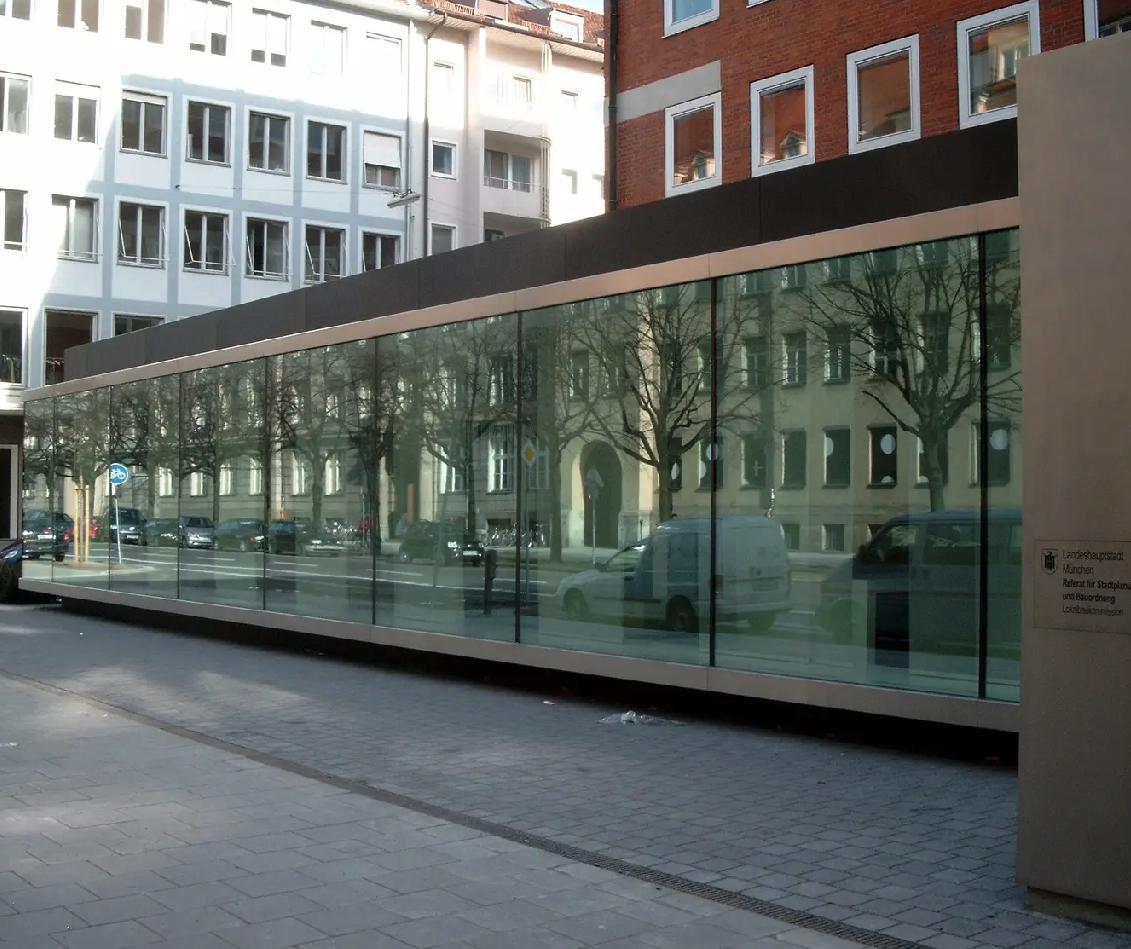
Today's fire-resistant glazing relies on considerably more capable constructions:

  • Multi-layer glass assemblies with functional interlayers that react to heat and form an insulating barrier layer.
  • Gel-based systems, in which a transparent (alkali) silicate layer reacts at high temperatures, evaporates and thereby creates a heat-insulating barrier.

Both variants now allow large glass formats, clear visibility in everyday use and a reliable protective effect in the event of a fire.

ARDOREX® Fire-Resistant Glass

Combined Requirements and Market Context

In practice, fire and smoke-control glazing is increasingly combined with further demands. Alongside safety, daylight, acoustics, design and ecological aspects are gaining weight.

Providers such as Isolar with Ornilux show that safety glazing is not considered in isolation but as part of a holistic architectural and usage concept. Choosing the right glazing thus becomes the interface between technology, design and responsibility.

Learn more about ORNILUX® Bird Protection Glass

What Fire and Smoke-Control Glass Cost

The prices of the two glass types can differ noticeably. The main factors include:

  • the required protective function,
  • the size and geometry of the glazing,
  • the frame system,
  • and the effort for planning, testing and installation.

Smoke-control glazing is structurally simpler and therefore cheaper. Fire-resistant glazing is more complex and requires tested systems, which is reflected in the price. At the same time, high-quality fire-resistant glazing often makes certain floor plans, uses or approvals possible in the first place. Against this backdrop, the extra costs are put into perspective by greater planning certainty and long-term benefit.

What Matters in Planning and Implementation

Anyone who wants to plan safely clarifies these points early on:

  1. Define the protection goal: Is smoke limitation the priority, or additionally protection against heat transfer through fire?
  2. Analyse the use: How many people, which escape routes, which adjacent uses?
  3. Coordinate the system: Glass, frame and fixing must match one another.
  4. Secure approvability: Only tested systems are permitted.
  5. Install professionally: Installation, position and maintenance are safety-relevant.

Early coordination between planning, specialist planning and execution saves later adjustments and additional costs.

Sustainability and an Outlook

Sustainability and future viability are moving to the fore for modern fire-resistant glazing too:

  • High UV stability and UV transmittance ensure durable material and prevent yellowing or ageing.
  • Pronounced colour fidelity, good colour rendering and detail sharpness maintain clear visibility and aesthetic standards over the years.

In parallel, manufacturers are working on more recyclable composite systems and material-efficient assemblies. In the future, fire-resistant glazing could even take on sensory tasks and become part of intelligent building concepts.

Smoke-control and fire-resistant glass fulfil different tasks. Smoke-control glazing secures room closure against smoke and hot gases. Fire-resistant glazing additionally protects against heat effects and keeps escape and rescue routes passable for longer.

The question is therefore not which glass is "better", but which protection goal must be achieved. Anyone who knows the fundamental differences and classifies the fire-resistance classes correctly plans safely, approvably and economically. For a technical deep dive into the E, EW and EI classes, a closer look is worthwhile.

Author: Arnold Glas Marketing Department

FAQ

What is the fundamental difference between fire-resistant glass and smoke-control glass?

Smoke-control glass stops the spread of smoke and hot gases. In tested systems, fire-resistant glass additionally protects against thermal radiation and limits the temperature rise on the fire-averted side.

When is smoke-control glass sufficient?

Whenever smoke is the main hazard and no critical heat effect on adjacent areas is expected — for example in corridors or smoke compartments.

When is fire-resistant glass needed?

As soon as, in addition to smoke and flame containment, the limitation of (critical) heat transfer is required — for instance in escape routes, stairwells or between fire compartments.

What do the E, EW and EI fire-resistance classes stand for?

They indicate which protective function a component provides in the event of fire — from pure room closure to limiting thermal radiation and temperature. They form the basis for planning and approval.

Is fire-resistant glass always more expensive?

As a rule, yes, because it is more complex. However, the extra costs are offset by more safety, better approvability and greater flexibility of use.

Can safety glass be combined with other functions?

Yes. Modern systems can additionally cover sound insulation, burglary resistance or design requirements — as long as the tested protective function is preserved.

Arnold Zentralverwaltungsgesellschaft mbH
Alfred-Klingele-Str. 15
73630 Remshalden
Routenplaner (www)