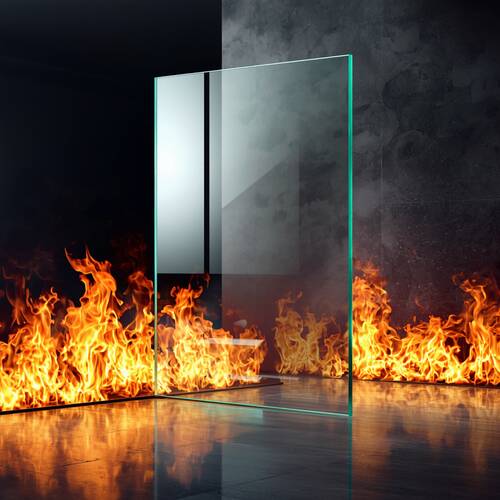
Fire Resistance Classes E, EW and EI: Meaning, Differences and Requirements
Why Fire Resistance Classes Are Essential in Fire Protection
In the event of a fire, the available time often determines the outcome of the situation. Fire, smoke and high temperatures must be confined to a limited area for as long as possible so that people can leave the building safely and emergency services have sufficient time to respond.
To ensure that building components perform this task reliably, they are tested according to established European testing procedures. One of the key standards is EN 13501-2. It defines how walls, doors, glazing systems and other building elements are assessed and classified in the event of a fire.
The fire resistance classes E, EW and EI describe the specific protective performance of a building component. They indicate which requirements are fulfilled and for how long these properties have been demonstrated during a fire test. Understanding the differences helps architects, planners and building owners better understand fire protection requirements and plan construction projects safely.
What Do the Fire Resistance Classes E, EW and EI Mean?
The three letters represent different protection objectives in fire safety.
E – Integrity
Class E certifies a building component's ability to prevent the passage of flames and hot fire gases. During the tested period, no fire may spread to the opposite side.
W – Radiation Control
In addition to integrity, Class W limits thermal radiation. This prevents people or combustible materials on the non-fire side from being exposed to dangerous levels of radiant heat.
I – Insulation
Class I represents the highest level of protection. In addition to maintaining integrity, the building component must ensure that the temperature on the side away from the fire rises only within specified limits. This reduces heat transfer to adjacent areas.
In practice, the letters are combined with a time classification. Examples include E 30, EW 60 and EI 90. The number indicates the number of minutes for which the building component has demonstrated the required performance during a fire test.
How Are Fire Resistance Classes Tested?
Classification is determined through standardized fire resistance tests. During testing, the building component is exposed to fire from one side according to the standard time-temperature curve (STTC).
Within a short period, temperatures inside the test furnace rise to well above 800 °C. Throughout the test, it is monitored whether the specified performance requirements are maintained.
The following criteria apply to each classification:
E
No passage of flames
No passage of hot fire gases
No unacceptable openings or cracks
W
Maximum thermal radiation of 15 kW/m² on the non-fire side
I
Average temperature rise of no more than 140 °C
Temperature rise at any individual measuring point of no more than 180 °C
If a building component meets these requirements for the specified test duration, it receives the corresponding classification.
For example, a building component classified as EI 90 provides integrity and insulation for at least 90 minutes.
What Does EI 60 Mean in Practice?
The fire resistance classification EI 60 means that a building component prevents the passage of fire and limits heat transfer to the opposite side for a minimum of 60 minutes.
In many fire tests, modern systems achieve performance durations that exceed the required minimum period. However, for regulatory approval purposes, only the officially tested and certified classification is relevant.
Why Is This Classification So Important?
Fire resistance classes are not only used to comply with legal requirements. They are an essential part of passive fire protection and help protect both human life and property.
The correct classification ensures that escape routes remain usable for longer periods, fire compartments remain effectively separated and fire cannot spread uncontrollably to other areas of a building.
Modern architecture in particular, with open floor plans and large glazed surfaces, requires carefully planned fire protection solutions that combine safety and transparency.
When Is EW 30 Used?
In several European countries, the fire resistance class EW 30 is used to limit thermal radiation in addition to maintaining integrity. This can provide additional protection for escape and rescue routes.
In Germany, however, this classification has only limited practical significance because it is rarely required by building regulations. Nevertheless, it is frequently referenced in connection with international projects and European standards.
Standards and Legal Framework
The classification of building components throughout Europe is based on the requirements of EN 13501-2. This standard defines how fire resistance classes are determined and designated.
In Germany, these requirements are implemented through the Model Building Code (MBO) and the respective state building regulations. These regulations contain the requirements for fire-retardant, highly fire-retardant and fire-resistant building components.
The fire resistance class required in practice always depends on the specific construction project and the applicable state regulations.
Typical requirements include:
Stairwells and escape routes: often at least EI 30
Separations between occupancy units or fire compartments: often EI 90 to EI 120
As requirements may vary between federal states, the required classification should be considered at an early stage of the planning process.