Beyond g-value and Ug-value: the figure that truly reveals glass quality
In contemporary architecture, the glass façade is no longer a passive component but a precisely tuned filter system. It has to manage the balancing act between maximum transparency and energy efficiency. Planners and clients usually look first at the Ug-value (thermal insulation) or the g-value (solar control). Yet a third figure says the most about the real performance of a glazing unit: the selectivity value. It describes how intelligently a coating works – and determines whether a room overheats in summer or stays bright and naturally lit despite effective solar protection.
1. What selectivity actually describes
Selectivity (S) is not a standalone physical unit but a ratio. It relates the light transmittance Tv to the total solar energy transmittance g (g-value). Under the European standard DIN EN 410, the formula is:
S = Tv / g
Light transmittance (Tv): the percentage of visible light (wavelength 380 to 780 nm) that passes through the pane into the interior.
Total solar energy transmittance (g-value): all incoming energy – the directly transmitted radiation plus the heat re-radiated inwards by panes that have absorbed and warmed up.
The goal is a high numerator (Tv) with a low denominator (g-value). If a glass lets in 70% of the light but only 35% of the heat, the result is a selectivity of 2.0.
2. From tinting to high-performance coatings
For decades, solar control was a compromise. Early glasses were either heavily tinted or metallically mirrored – as the g-value dropped, light transmittance always collapsed with it. The consequence: occupants sat cooler but had to switch on artificial light even during the day. A poor deal both energetically and for the feel of the room.
The breakthrough came with the magnetron sputtering process. In a high vacuum, ultra-thin precious-metal layers – usually silver – are applied to the glass. Depending on the layer structure, different performance classes emerge: double-silver coatings reach selectivity values of around 1.8 to 1.9, while modern triple-silver technologies exceed 2.1 in selected high-performance products.
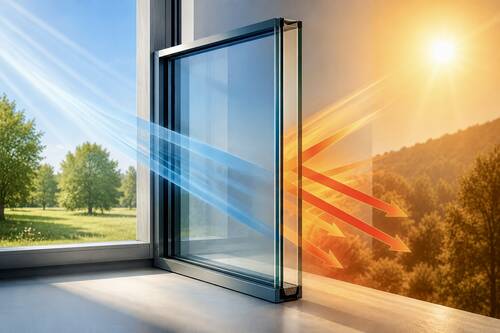
These coatings act as spectral filters: they let short-wave visible light pass largely unhindered while reflecting a large part of the long-wave infrared radiation – the heat. This combines plenty of daylight with effective summer heat protection.
3. Why 2.0 serves as a benchmark
In professional planning, the selectivity value is a key performance indicator for solar control glass. Which value makes sense depends on use, building type and façade concept. Especially for demanding glazing, high selectivity values are gaining importance.
Daylight is the cheapest and healthiest light source in a building. Studies on biophilic design show that natural light reduces absenteeism and boosts concentration. A highly selective glass lowers cooling loads and noticeably increases daylight autonomy. Broad product families – such as the more than 60 variants of the SOLARLUX® range – make it possible to choose exactly the right S-value for each project: from highly neutral solutions like SOLARLUX® E71 to reflective variants for special design requirements.
Glazing types in an energy comparison
Glazing type | Tv (%) | g-value | Selectivity (S) | Characteristics |
Standard insulating glass | 80 | 0.62 | 1.29 | Lots of light, lots of heat |
Low-E insulating glass | 75 | 0.55 | 1.36 | Focus on winter insulation |
Solar control glass (basic) | 62 | 0.40 | 1.55 | Solid protection, darker |
SOLARLUX® A71 (high-perf.) | 70 | 0.37 | 1.89 | Balance & neutrality |
SOLARLUX® X60 (highly sel.) | 60 | 0.28 | 2.14 | Maximum heat protection |