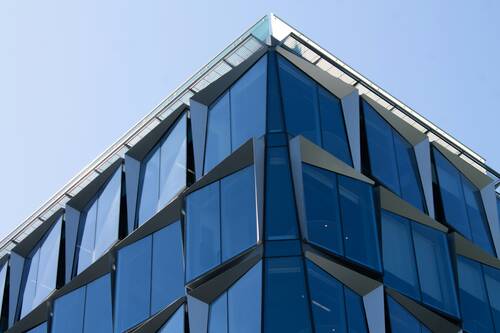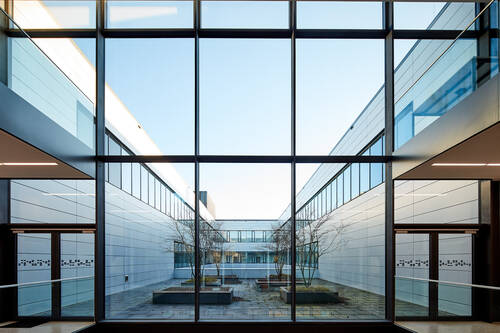
Glass façades today have to deliver two things that can work against each other technically. They must intercept solar loads so interiors stay usable through high summer – and at the same time they must be structurally safe, for people inside the building and below it. Both requirements meet at the same pane, which is why the decision between toughened and laminated safety glass is rarely made on safety grounds alone.
Why solar control is a safety issue at all
Solar control glass works with wafer-thin selective coatings that let visible light through while reflecting or absorbing the sun’s short-wave infrared radiation. That absorbed share is exactly where safety enters the picture.
Absorbed energy is converted into heat within the glass. If part of the pane sits in shade – from a lintel, a reveal, a neighbouring building or internal shading – temperature differences arise within a single pane. The warmed areas expand, the cool ones do not. Once the resulting stress exceeds the strength of the glass, thermal breakage occurs. Toughened glass is not a comfort option here; it is a technical precondition.
MONOPACT® (toughened): the façade’s thermal buffer
Toughened safety glass is produced by heating float glass above 600 °C and then cooling it rapidly. This builds permanent compressive stresses at the surface and tensile stresses in the core. At Arnold Glas the result is called MONOPACT®, and it changes three properties fundamentally.
The physics behind it
Resistance to temperature change: where ordinary float glass breaks at temperature differences of around 40 K, toughened glass withstands differences of roughly 200 K. That is the real reason for using it in strongly absorbing solar control build-ups.
Bending strength: the pane tolerates considerably higher wind loads and mechanical impact – relevant for large formats and exposed locations.
Fracture pattern: on failure, toughened glass disintegrates into a network of small, blunt-edged fragments. The risk of serious cut injuries drops substantially. The pane retains no residual load-bearing capacity afterwards, however – and that is precisely where its application range ends.
PRODUCT PAGE: TOUGHENED GLASS
Formats, thicknesses and toughening grades at a glance: MONOPACT® toughened safety glass
MULTIPACT® (laminated): structural safety with added value
Laminated safety glass consists of two or more panes permanently bonded under heat and pressure with a tear-resistant polyvinyl butyral interlayer. At Arnold Glas this runs under MULTIPACT®. The interlayer holds fragments within the assembly – which gives rise to the classic applications.
Safety through residual load-bearing capacity
Fall protection: glass balustrades and floor-to-ceiling windows must protect people from falling even after breakage. Only a laminate with residual load-bearing capacity achieves this.
Overhead glazing: above occupied areas, laminated glass prevents fragments from falling. Toughened glass alone is generally not permitted there.
Burglary resistance: depending on build-up and interlayer thickness, the laminate offers graded protection against penetration or breakthrough.
The hidden benefit: UV protection and acoustics
Two further effects are often underestimated in specification. The PVB layer blocks UV radiation almost entirely – close to 100 per cent is held back, so furniture, textiles and exhibits fade noticeably more slowly. And the laminate dampens sound waves, which makes it an obvious building block for noise-exposed façades; developed systematically, that leads to AKUSTEX® acoustic glass.
The laminated build-up also combines with further functions – for instance with ORNILUX® bird protection glass, where collision reduction is required alongside structural safety.
The bridge to solar control: the g-value
Total solar energy transmittance describes what share of solar energy actually reaches the room. Modern solar control glass achieves g-values around 0.28 – so a good 70 per cent of solar heat energy is held back, partly by reflection, partly by absorption within the glass itself. The underlying principles are covered under selectivity in glass.
One rule for specification: never consider the g-value in isolation. A very low value can darken interiors undesirably and increase the need for artificial light. Only the ratio to light transmittance is meaningful. And the higher the absorption share of a coating, the more compulsory toughening becomes – SOLARLUX® solar control glass lists the values for each variant.
CALCULATE THE FIGURES
Determine Ug-value, g-value and light transmittance for specific build-ups: ISOLAR® Calculator · Work through build-ups systematically: ISOLAR® Compass